Transforming Fleet Management: How Novus Hi-Tech and AWS Built FleetGPT to Prevent Road Accidents at Global Scale

Managing thousands of commercial vehicles streaming continuous telemetry, dashcam video, global positioning data, and high-frequency sensor warnings across multiple international borders represents one of the most complex logistical challenges in modern enterprise logistics. At such a monumental scale, human operators quickly become overwhelmed, unable to manually triage thousands of simultaneous driver drowsiness warnings, sudden braking alerts, and over-speeding events before they escalate into catastrophic road accidents. Addressing this critical operational bottleneck, fleet analytics provider Novus Hi-Tech has successfully deployed an advanced agentic artificial intelligence solution named FleetGPT, engineered in close collaboration with the AWS Prototyping and AI Customer Engineering team.
The implementation of this multi-agent architecture has fundamentally transformed how Novus Hi-Tech monitors its global operations, which currently span more than 120 enterprise customers. By shifting from passive, dashboard-driven monitoring to proactive, automated safety interventions, the company achieved a remarkable 46 percent reduction in road-behavior violations and a 55 percent decrease in drowsiness alerts per 1,000 kilometers traveled. This technological leap highlights a broader industry shift toward autonomous, event-driven infrastructure capable of mitigating human latency in high-stakes operational environments.
The Structural Limitations of Traditional Fleet Monitoring
For years, extracting actionable intelligence from commercial vehicle telematics required extensive manual oversight. When an advanced driver assistance system triggered a drowsiness warning or an over-speeding flag, human operators were forced to manually validate video footage, cross-reference multiple sensor streams, assess the severity of the incident, contact the driver, and meticulously document the outcome in internal logs. Standard enterprise dashboards offered static, one-size-fits-all visualizations that failed to adapt to the distinct, real-time requirements of command center operators, compliance officers, and executive fleet managers.
As fleets grew, this manual paradigm encountered severe scalability limits. Organizations simply could not hire and train enough personnel to monitor every live warning stream in real-time, transforming manual data analysis into a critical operational bottleneck. In the high-stakes domain of commercial transport, the cost of a single missed warning can translate into severe injuries, fatalities, regulatory penalties, and significant property damage. Furthermore, different stakeholders within a transport organization require radically different insights. Command center operators demand immediate, tactical interventions for active emergencies; fleet managers require broad pattern recognition to identify high-risk routes and erratic drivers; and customer success analysts need rapid compliance reporting. Traditional monitoring software forced all these roles through the same rigid interface, exacerbating friction and delaying response times.
Architecting FleetGPT: A Multi-Agent AWS Solution
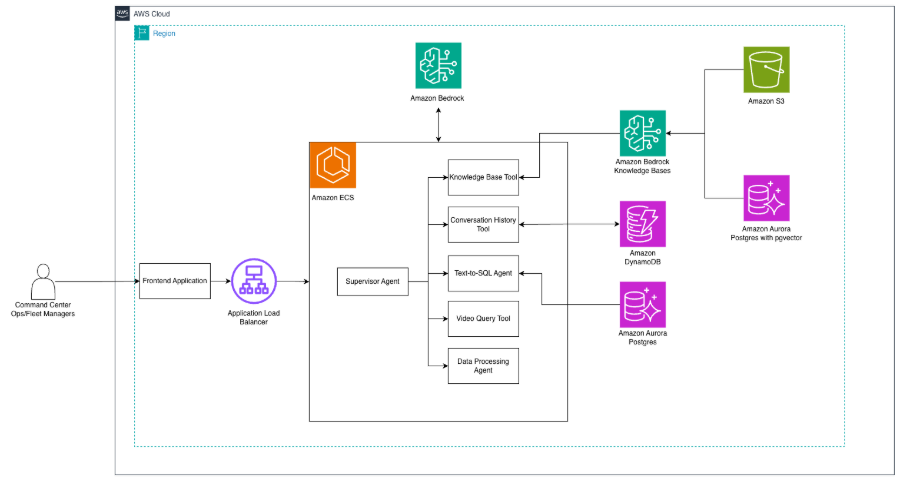
To overcome these structural limitations, Novus Hi-Tech partnered with AWS to design FleetGPT, replacing static dashboards with a dynamic, natural language conversational interface. Built utilizing the Strands Agents SDK and a suite of managed AWS artificial intelligence services, FleetGPT unifies fragmented data siloes—including telematics, video archives, and corporate standard operating procedures—into a cohesive, highly responsive ecosystem.
The technical architecture relies on a robust data storage and processing foundation tailored for high-velocity IoT streams. Amazon Aurora PostgreSQL serves as the analytical backbone, storing daily vehicle aggregates such as total distance, fuel consumption, safety scores, and GPS statistics, alongside live vehicle statuses. To bridge the gap between human language and database queries, the system employs a Text-to-SQL pipeline grounded by a comprehensive YAML schema injected into LLM prompts, significantly reducing SQL syntax errors and table hallucinations.
Concurrently, Amazon DynamoDB manages the high-velocity stream of warning events. By implementing a composite sort key combining warning codes and timestamps, the system executes rapid range queries by event type without requiring resource-intensive full-table scans. Tenant isolation and security are strictly maintained via Global Secondary Indexes scoped to individual enterprise fleet identifiers. Unstructured organizational knowledge, including compliance policies and safety manuals, is indexed using Amazon Bedrock Knowledge Bases, leveraging Amazon Titan Text Embeddings V2 and Amazon Aurora PostgreSQL with pgvector for precise semantic retrieval.
Orchestration and Specialized Sub-Agent Workflows
At the core of FleetGPT’s intelligence is a sophisticated multi-agent hierarchy orchestrated through the Strands Agents SDK. At the apex sits a Supervisor agent powered by advanced language models, responsible for intent decomposition, multi-step reasoning, and dynamic task routing. To maintain conversational continuity without inflating token costs, the system incorporates advanced conversation management tools that preserve recent dialogue verbatim while summarizing older interactions.
The Supervisor delegates specialized computing tasks to distinct sub-agents. The Text-to-SQL sub-agent executes plan-and-execute workflows to retrieve structured database metrics. When queries require advanced data science workflows—such as statistical profiling, correlation analysis, or predictive trend detection—the Supervisor delegates the task to a dedicated Data Processing sub-agent. This agent generates and executes safe Python code within a managed runtime environment, delivering tailored analytical insights efficiently.
Hosting is managed via AWS Fargate for Amazon Elastic Container Service (Amazon ECS), providing a fully serverless, highly scalable container environment fronted by an Application Load Balancer. This decoupled, microservices-based approach ensures that individual components can scale independently based on real-time traffic demands from thousands of connected commercial vehicles.
Real-Time Intervention and Automated Voice Calling
Beyond advanced analytics, FleetGPT functions as an active safety intervention engine. When critical telemetry events—such as severe drowsiness, dangerous acceleration, or emergency SOS triggers—are captured by edge hardware, Amazon DynamoDB Streams instantly capture the event data. A background worker service evaluates event severity and queues automated interventions.
When direct driver engagement is required, the system initiates a real-time, two-way AI-powered voice call conducted in the driver’s native language. Leveraging low-latency speech-to-text and text-to-speech models, the voice agent assesses the driver’s alertness, provides immediate safety warnings, tracks verbal acknowledgments, and escalates unresolved incidents to human command center supervisors. This end-to-end automation drastically reduces the time window between hazard detection and corrective action, transforming fleet safety protocols from reactive post-incident investigations into active, real-time risk prevention.
Measurable Operational Impact and Future Horizons
The deployment of FleetGPT across Novus Hi-Tech’s global enterprise network has yielded profound operational enhancements. Beyond the documented 46 percent reduction in general road-behavior violations and the 55 percent decline in drowsiness alerts per 1,000 kilometers, the platform has drastically compressed operator investigation times from minutes to mere seconds. Fleet managers can now query complex behavioral trends across thousands of vehicles instantly, eliminating the need for cumbersome data extraction tools or manual report generation.
Looking forward, Novus Hi-Tech plans to expand FleetGPT’s capabilities by integrating Amazon Bedrock AgentCore for enhanced agent optimization at scale. Furthermore, the company is developing predictive risk-scoring algorithms capable of evaluating historical driver telemetry to flag deteriorating performance patterns before safety violations occur. Future iterations will also introduce embedded chart and data visualization generation directly within conversational responses, bridging the final gap between raw analytical insight and executive presentation.
As commercial transport networks continue to expand globally, the success of FleetGPT offers a definitive blueprint for enterprises managing large-scale IoT data streams. By combining robust cloud infrastructure, specialized multi-agent architectures, and automated real-time interventions, organizations can successfully transition from passive data observation to intelligent, autonomous operational control.
Related posts: